



-
Warehouse find: 1951 Packard Patrician 400


“Ask The Man Who Owns One”
It seems like everyone in Detroit area has heard the name “Packard” and knows the “Packard Plant”, but not that everyone know what Packard cars looked like. Or some people may not even put one and one together: Yes, the Packard automobile was build at Packard Plant. The plant is located at 1580 E Grand Blvd, Detroit, MI 48211. More about the plant later in a different story, let´s take a look at the featured vehicle on this article.
1951 Was the first year for Packard´s redesigned new, much more sleeker body style than it´s predecessor. 1951 lineup consisted of four different models: 122″ wheelbase 200 and 250, and longer 127″ wheel base 300 and 400 models. The 400 was called “Patrician”, and it was only offered as a 4d Sedan with 127″ wheelbase. The only engine option for 400 was 327 cid , 150 bhp, straight 8 engine.

1951 Packard Patrician 400 at Packard Proving Grounds. 1951, Detroit Public Library 1951 Packard Production Model name Production figures 200 71,362 250 4,640 300 15,309 400 9,001 Total 100,312
1951 Packard Production Figures

Comparison between “the old” 1950 Packard Super DeLuxe and “new” 1951 Packard 300. As you can see, the difference between the two is significant. The Black 1951 Packard Patrician 400 in the photos belongs to my brother, Mika. He was looking for a – preferably black – 300 or 400 1951 model for some time until he came across this example for sale in Tennessee. It was advertised as a part of a larger collection of about 50 cars with seller hoping to downsize. The car was covered in thick dust on the photos and had not been running in years. Based on the photos, the condition was great: it had only 40,000 miles; engine compartment looked clean; the original interior even had the factory plastic covers on them! There was only one problem, the keys were lost. The seller didn’t know too much about the car, so the mechanical condition remained a mystery.
Because the vehicle looked great otherwise, Mika decided to take the chance and got in agreement with the seller on price and next steps. Of course, the next steps meant that I have to drive to Tennessee and bring the car home to Michigan, before shipping it to Finland to my brother. Trip to Tennessee went without any problems and Packard was loaded on a trailer in about 30 minutes. The seller had some other cars up for sale as well, there were quite a few Packards. So, in case anyone is looking for one, you know where to find them. The entire trip took 1.5 days (1,200 miles).

1951 Packard Patrician 400 pulled out of a storage 
On our way back to Michigan from Tennessee. The Packard Cormorant (aka the hood ornament) on this thing is HUGE ! 


Once I was back home, assessing the purchase started. It was quite stunning how well the car had been preserved over the years. It’s year 2023, so the Packard is now 72 years old! The plastic seat covers looked like new, headliner looks like new, dash is perfect etc. Someone had definitely done some work to it in the past. It looked like fuel line/cooling lines have been replaced and someone had installed electric fuel pump and insulated the fuel lines – maybe because of vapor locking in the hot summer? The battery had a sticker from 2008 and it was covered in white oxidation, so that was the first thing on the list. By the way, in case someone is wondering – this is a 6 volt system, instead of the more modern 12 volt. However, 1951 Packards have positive ground! How weird is that.. But… no matter how much I searched, there were no keys anywhere. It was time to find a locksmith.
Finding a Locksmith is like finding a needle in the haystack
For some time, I had been wondering why the seller didn’t call a locksmith and get the keys for the car. You would think it would be easier to sell?
After calling through some more common locksmith companies, it started to sound like a mission impossible. Every time, I mentioned the make and model I was told “we don’t work on anything that old”. One company, even just said “no” and hanged up without even ending the call. It felt like lot of this places went to a call center somewhere, and they just did not have any interest of doing anything that differs from the daily routing work. Maybe the seller just gave up? Finally, I managed to find a local company that advertised they do keys for classic cars. It felt like a jackpot. The person on the phone even showed some interest on the vehicle and asked me to send photos of the car, locks, key blanks (yes, my brother had already ordered Packard key blanks) and any other info that I had regarding the keys. The only problem.. quote was minimum of $500 – possibly somewhere closer to $1,000. For two keys??! Either the person didn’t know what he was doing, or just wanted to cash out, because it was a classic car. Either way, I said no.
Finally, I found a company called Birmingham Locksmith Services. They were able to do it, and the quote sounded much more reasonable. It might be worth mentioning, that because there were no keys, I couldn’t open the trunk, glovebox or – obviously – start the car. Next day, the locksmith showed up and after a while he managed to pop up the trunk lid.test test
-
The Legacy Run: 1973 Chrysler New Yorker – A Route 66 Centennial Project


1.The Legacy Run: A Tribute in Motion
Some journeys begin long before the engine turns over.
This one began with a friendship, a forgotten car, and a shared love for American roads.In the summer of 2024, I found myself standing beside a 1973 Chrysler New Yorker buried in weeds — a car that once belonged to my friend Hans Granberg, a fellow Finnish Mopar enthusiast whose passion for American automotive history matched my own. On his final visit to the United States, Hans used this Chrysler to tour across the country, especially throughout the Detroit area. He had plans to return, to drive it farther, to see more. But life had other plans.
After his passing, the car sat still. But it was never forgotten.
Bringing it back to life wasn’t just any project.
I moved to the United States for the very culture this car represents: the heritage of American engineering, the spirit of the open road, and the stories that live in chrome and steel. Reviving the Chrysler became a way to carry forward a piece of that culture.Then came the moment that changed everything. The car was part of a multi‑vehicle crash with almost no damage, a scene that quickly went viral and reminded people of the durability and soul of classic American automobiles. Suddenly, this wasn’t just a tribute — it was a symbol of resilience, craftsmanship, and the kind of engineering that built the legends of the American road.
Now, the Chrysler is heading down Route 66 as part of the centennial celebration.
The Legacy Run is more than a road trip. It’s a memorial in motion. It’s a way to connect past and present, to honor the people and machines that shaped our journeys, and to share those stories with others who understand what it means to love the road.We’ll be documenting every mile — from neon-lit motels to desert stretches, from roadside diners to historic landmarks. But more than that, we’ll be sharing Hans’s story, the car’s story, and the stories of the people we meet along the way. This project is built on friendship, heritage, and the belief that some cars carry more than passengers — they carry meaning.
This is our way of honoring a friend, celebrating a century of Route 66, and keeping the spirit of the open road alive.

Hans and the seller in Kansas 2013 Who We Are
Markku Jaakkola and Jacob Gilbert are the co‑leads behind The Legacy Run, working side by side to bring the 1973 Chrysler New Yorker — and the story behind it — back onto the open road. Together, they share responsibility for planning the journey, documenting the experience, engaging with communities along Route 66, and honoring the legacy that inspired the project.
Markku is a Finnish‑born automotive storyteller and Quality Engineer who moved to the United States driven by a lifelong passion for classic American cars and the culture surrounding them.Jacob brings a steady problem‑solving mindset, a deep love for American road‑trip traditions, and a commitment to preserving the stories found along the Mother Road.
As a team, they combine their strengths — heritage, technical knowledge, creativity, logistics, and a shared respect for the history of Route 66 — to ensure that The Legacy Run is not just a drive, but a meaningful tribute carried out together.
The RouteWe are starting from Detroit on Saturday August 1st from Pasteiner´s Autozone book store´s Cars and Coffee event. There is about 300 classic and exotic cars at the show. Then we will drive through Detroit to Chicago, take the Route 66 to Los Angeles and continue on Pacific Coast Highway up to Monterey, California. We will participate on Concours D´Lemons at Monterey´s Car Week on Saturday August 15th.
Source for Route 66 Map
The drive will start from Detroit and end up to Monterey 3. Support the Journey
This project is more than a road trip. It’s a tribute to a friend, a piece of automotive history, and a promise I made to keep a story alive.
In 2024, my friend Hans — a lifelong Mopar enthusiast from Finland — passed away unexpectedly. Before he left us, he toured the United States in his 1973 Chrysler New Yorker, a car that became part of his identity. After his passing, I brought that same New Yorker back to life and committed to continue its journey on the American road.
The car itself survived a widely reported crash a year ago, adding another chapter to its long and unlikely story.
In 2026, the car and I will take part in the official Route 66 Centennial, traveling the Mother Road from Chicago to Santa Monica as a living tribute to Hans, to American automotive culture, and to the people who keep these stories alive.
If you’d like to support this journey, you’re welcome to contribute.
Your support helps cover travel, documentation, preservation, and the costs of keeping a 50‑year‑old survivor car on the road for a once‑in‑a‑century event.Contributions are voluntary and are not payments for goods or services.
They’re simply a way to stand behind the story, the car, and the legacy that inspired this project.Thank you for being part of this road ahead — it means more than you know.


 1973 Chrysler New Yorker, American road culture, Automotive legacy stories, Automotive storytelling, Classic American cars, Classic car revival, Cross‑country car journey, Historic Route 66 travel, Mopar history, Route 66 Centennial Project, Route 66 road trip, Route 66 travel blog, Survivor car restoration, Tribute road trip, Vintage Chrysler V8
 -
1971 Lincoln Mark III and Continental : The Phaeton Edition


I thought it would be cool to write couple words about the 1971 Lincoln Mark III Phaeton Editions. There’s not too much information about them online, but I managed to find few advertisements few years back from eBay.
The name Phaeton comes from Greek-mythology. He was the the son of the Oceanid Clymene and the sun-god Helios.
Phaeton editions were a package offered by a Eagle Coach Co., a coach builder and a dealer, in Dallas, Texas on 6116 Lemmon Avenue.In 1971 or the prior years when the Mark III was available – 1969 and 1970 – factory did not offer any special edition packages for Mark IIIs. So, no wonder that coach builders and dealers came up with their own versions to lure in more customers.
According to automotivemileposts.com, The Phaeton package, cost $687 extra on top of the Mark III MSRP price. All 1971 Lincoln Mark IIIs came with vinyl tops as a standard option, but Phaetons were ordered as “District Special Order (DSO)’ through Oklahoma City District.
Option Package included:- Custom Phaeton Vinyl Roof
- Custom Phaeton Vinyl Deck Lid Cover
- Golden Anniversary Pinstriping
- Luxury Chrome Spoke Wheel Covers
- Phaeton Fender, Deck Lid and Wheel Emblems
- Phaeton Mark III Hood Ornament
- Phaeton Gold Line Limousine Tyres by Vogue
- Heavy Duty Undercoating
- Blue Coral Fashion Wax Treatment
- Phaeton Landau Irons (Additional $159)
I haven’t been able to find production figures for the Phaeton models, but it must have been really low. However, they do seem to pop of for sale every now and then.

Phaeton emblem. Phaeton was the son of sun-god Helios in Greek-mythology.
1971 Mark IIIs were not the only Phaetons Eagle Coach Co. was offering. For 1971 There was also a Lincoln Continental Phaeton Limousine offered, which was converted from Lincoln Continental base sedan.

Specifications:
- Overall Length: 264.2″
- Wheel Base: 163.2″
- Overall Heights: 55.5″
- Overall Width: 79.5″
- Front Tread: 64.3″
- Rear Tread:64.3″
- Tire Size: L-78-15 (Load Range D)
- Curb Weight: 5700 Lbs.
The Phaeton Limousine features included:
- Mark III styled Phaeton Grille with pennant Pylons on etiher side of the grille
- Bumper guards
- Phaeton Hood Ornament
- Custom Phaeton Limousine Tyres by Vogue
- Power Sun Roof
- Custom Roof finished with cavalry twill vinyl
- Phaeton Landau Roof irons
- Continental Deck Lid
- Phaeton Limousine Lounge interior
There were also other model years besides 1971. I found brochures upto 1975 or 1976, when the Town car design was upgraded with some of the Mark IV features. The advertising slogan was “The Phaeton Town Car is designed for the individual who wants a Mark IV, but demands the comfort, spaciousness and convenience of a 4-door. The styling, attention to detail and the many luxury options however makes this more a personal sized Mark IV limousine but price for the practical minded buyer. Truly the most elegant car in its class on the road today.
1974 Lincoln Mark IV Phaeton Edition from Eagle Coach brochure. See how many features were offered.
1974 Lincoln Continental Phaeton Town Car features.
Do you own one of these ? Let me know below in the comments.
-
Preserving the Patina – Poppy's Patina Review

My 1950 Ford’s paint has some pretty outstanding patina and surface rust. Because getting the powertrain rebuilt is the priority #1, I am not planning to paint it just yet. However, I want to preserve the current patina so that it doesn’t get any worse. Poppy’s Patina has a perfect product to preserve the current look and protect whatever is left of the paint.
The reason why Poppy’s is great for my project, is that it’s a urethane clear coat, like any other clear coat it’s permanent. However, you can also paint over it or sand it off later if you want to.
Let’s see how it works.


1950 Ford Custom Deluxe Convertible ready for the clean up.
The Poppy´s Patina wipe on clear coat on the 1950 Ford shines better than my 1960 Thunderbird – which has original paint..
I started with washing the exterior with some simple green / water mix to get all the dirt off from the body. I assume no one has washed it since the Ford made it’s way to Colorado Springs in 1962!
Poppy’s Patina sent me the “The Whole Shebang Kit (Gloss)“ .
The Kit includes:
1 x Pre-Cleaner
1 x Wax & Grease Remover,
1 x Gloss Wipe-On Clear Coat
1 x Can of Catalyst
1 x Wash & Wax
1 x Detail Spray w/ Ceramic
1 x Bag of Recycled Knit Wiping Rags
3 x Grey Light Duty Scuff Pads
2 x Applicator pads
On top of that I purchased from Home Depot:
2 x Paint mixing cups
2 x Paint mixing sticks
2 x pairs of rubber gloves
2 x blue masking tape
1 x Paint tray
3 x Paint tray inserts

1950 Ford Custom Deluxe Convertible after the pre-cleaner wash (Step 1).
The Process
Let’s go though everything step by step.
Step 1. Pre-Cleaner
Using the “pre-cleaner” is pretty straight forward. Mix 2 oz per 1 gallon of water. Then scrub the exterior surface with the grey scuff pads. After all the scrubbing, you just rinse the surface with water. I can’t believe how dirty the car was, even after washing it with simple green first, but scuffing pads really made the difference.Step 2. Masking
Mask all the trim with the masking tape to protect the areas you do not want the clear coat on. This is the most time consuming part.Step 3. Wax and Grease Remover
After washing the car with pre-cleaner and masking everything, you will need to get rid of all the possible wax and grease on the paint. That’s where the “Wax and Grease Remover” comes handy. You wipe it on with one of rags that came with the kit and wipe it off immediately with another rag.
Step 4. Clear Coat, first layer
Time to apply the clear coat! First you need to mix the “Wipe-on Clear Coat” with “Catalyst”. Ratio is 8:1. I mixed 16oz of Clear to 2 oz of Catalyst. It was a bit more than I needed for the car, but note, it’s a convertible, so I did not have to coat to roof. Once you have mixed the two, you can start applying the clear coat on with the white applicator pad. Instructions advise to use compressed air to blow the pads first, to make sure they are clean. I used this video as a guide to learn how to apply the clear coat on Poppy’s Patina’s YouTube channel. You just basically wipe it on with the pad.Step 5 – Clear Coat, Second Coat
Once the first coat has cured -for 24 hours. You can add a second coat. It’s not necessary, but I decided to see if makes a difference.
First you need to use one of the scuffing pads to lightly scuff the first coat. Then you just repeat the Step 4 and you are done.Final Thoughts
The results are what I expected, or maybe even little better. Because I wiped the product on with the pads that came with the kit, I wasn´t expecting perfect results. (Note that you can also use a spray gun to apply the product on your vehicle). You can for example see some “wipe marks” (for lack of a better term) on the surface. Also, there was a minor chemical reaction with the paint on left front fender. The product details did mention this might happen when clear coat is applied on low quality paint. I will add some photos for you to see better. The surfaces where there was no paint at all or had surface rust, I think it needed the second coat. But they turned out great !
On the positive side, it was easy to use, it definitely added depth on the paint colors. Poppy´s Patina wipe on clear coat on the 1950 Ford shines better than my 1960 Thunderbird – which has original factory paint! And most importantly, it will also It seal the surface rust and prevent further deterioration. The Ford won´t be getting any worse.

Before and After. The photo on the right shows the surface after two coats of clear (step 5).


The left photo shows paint after the clean up and ready for clear coat (step 3). The photo on the right shows the surface after two coats of clear have been applied (step 5).


Right rear fender and side after the scrubbing (Step 3) and again after two coats of clear coat (step 5).


Bare metal and surface after two coats of clear coat (step 5). They are definitely protected from further deterioration.


Hopefully you can see the couple defects on these photos. Trunk lid shows some “wipe marks”, but I couldn’t really see them elsewhere. The second photo shows left fender which had a chemical reaction with the old paint. These are photo taken after the second coat of clear (step 5).

The clear coat turned out great! This photo is after the 2 coats of wipe on clear coat (step 5).
-
Detroit Concours D’Elegance Media Day 2023


I was excited to be invited to 2023 Detroit Concours D’Elegance Media event. It was held at the Detroit Institute of Arts, same location where the actual Concours event will be on September 22nd and 23rd. The event included few classic cars, lots of networking, presentation and – of course – a lunch.
I arrived a bit early to be able to check the cars before everyone else arrived. This was the media event, so obviously there weren’t many vehicles, but some cool stuff was brought in: 2 Rolls Royces, 2 Ferraris, a 1967 Camaro SS and my favorite : Red 1953 Buick Skylark.
Event started with looking at the vehicles and taking some photos. As you might already know, I am more into the domestic cars (which sounds kind of funny, as I am a foreigner. For a Finn all cars are foreign cars – but you get the point – American built cars are my favorites!). So, I was mostly taking photos of the 1953 Buick Skylark,After looking at the vehicles on display, we moved inside to listen to the presentation. I’ll try to list the main points of it here.
This years Detroit Concours D’Elegance campaign is called ‘Powered by Detroit’ and it honors the people who put the world on wheels by highlighting their vehicles and stories. The big question on the event was : Do People Still Love Cars ? The answer is, yes they do. In the car industry everyone is talking about the autonomous driving, but people still like to drive their vehicles. McKeel Hagerty (who is the CEO of Hagerty and Chairman of Detroit Concours) shared some astonishing numbers : In United States alone, there are over 67 Million Car Enthusiasts and 45 Million Collector Cars – bear in mind that in 2023 US Population is 332 million, so the % for enthusiasts and collector cars is quite high! Which is of course great news for us, who like driving, horsepower and car design.Below are some of the Highlights:
Hagerty’s upcoming events are:
- Concours d’Lemons (8/19/2023)
- RADwood Detroit (9/16/2023)
- Detroit Concours (9/22-23/2023)
For this year there are some updates for the show. There will be total of 150 vehicles and 21 classes. Ed Welburn (Retired, General MotorsVice President of Global Design) will be The Chief Judge.
Featured Classes:
- Designs of Gordon Buehrig, Featuring the 1948 Tasco Prototype
- 57 Heaven (Cars from 1957)
- Mopar Magic
- Ferraris from the 60s
- American Sports Cars of the ’50s and ’60s
- Concours of America All Stars(Best in Classfrom 1979-2021)
- Powered by Detroit
Celebrations:
- 120th Anniversary of Buick
- 75th Anniversary of Porsche
- 60th Anniversary of Lamborghini
- 60th Anniversary of McLaren
- 120th Anniversary of Harley Davidson
Featured Student : Siddharth Camarushy
Here’s the link to the event website : https://www.detroitconcours.com/ for more details.
-
The Role of Artificial Intelligence in Advancing Automotive Art

I´m new to the Artificial Intelligence apps and how they work, so I wanted to try out couple simple ones and see what type of classic cars they could generate.
Have you ever been driving on the highway and noticed a car that looks like it was designed by a computer? It may seem like a futuristic concept, but this is a reality now thanks to the emergence of artificial intelligence (AI) applications in the automotive art industry. AI is not only being used to design cars, but also to create artwork for them.
AI-driven automotive art has the potential to revolutionize the industry, as it provides a unique and efficient way to customize vehicles. AI can be used to generate intricate and complex designs that would otherwise be difficult to create manually.
One of the most exciting applications of AI in automotive is in the field of car design. As mentioned above, AI can be used to generate intricate and complex designs that would otherwise be difficult to create manually. The designs are based on certain criteria such as aesthetics, functionality, and user preferences.
AI can also be used to create virtual prototypes of cars, which can be used to test the design before it is actually made. This can save time and money as it eliminates the need for physical prototypes.In addition to car design, AI can create unique and intricate artwork of cars from simple patterns to complex and detailed designs. Which the examples in this article refer to. These designed are based on certain criteria such as color, texture, and user preferences. Benefits of the AI in automotive art is that it provides an efficient and cost-effective way to create unique and intricate artwork for cars. AI-driven painting techniques can also be used to customize cars in an individualized way. Which I think will benefit of the future of classic car customizing.
As the technology continues to advance, it is likely that AI applications in automotive art will become even more commonplace.
Examples of AI generated Classic Car Automotive Art
Unfortunately, I don´t have access to professional level AI tools, so I got couple different ones from Apple Store for my iphone. The ones I picked up from Iphone´s app store were “AI Art Generator, Image Maker” by Ozgur Sahin with 4.2 star rating and “Artist.ai” by Livintis W.L.L. with 4.6 star rating. They are both free apps with possibility to upgrade them with more features and both for the same way, but let´s look at the Artist.ai which gives you 3 options to generate art:
- By describing your artwork and choosing the art style.
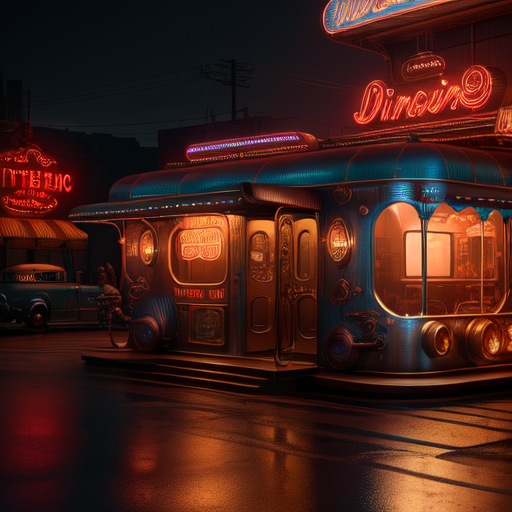
Let´s start with Artist.ai. I used “1959 Cadillac in front of a diner” as a description and 3D Art style . After selecting the parameters you can select “Details” which means how many steps the software spends generating the image. I chose highest option “50”. Then you can adjust the “prompt guidance” – higher the prompt, the more closer the loser your image will be to your prompt. This is all you need to do and then the software creates an image based on your settings.

“1959 Cadillac in front of a diner” created with Artist.ai iPhone app.
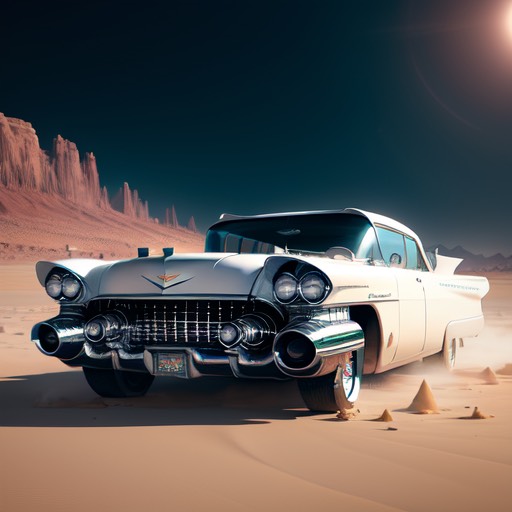
Next, Let´s try the “AI Art Generator, Image Maker” and see what we get.. Unfortunately, the AI art generator thinks “1959 Cadillac in front of a diner”, means the front of the vehicle. So I had to change it to “1959 Cadillac at a diner” with Style set at “3D”.

“1959 Cadillac at a diner” created with AI Art Generator, Image Maker iPhone app.
In my opinion the “Artist.ai” created a better looking overall vehicle. It resembles the 1959 Cadillac with large tailfins, dual headlights, fenders and grille-bumper design. However is much more futuristic. On the other hand “AI Art Generator, Image Maker” added a 1954-56 Cadillac looking roof, 1961 ( ? ) tail find and a bit of a messy looking headlights. Note that you can give more definitions, for example adding “Black 1959 Cadillac… ” on the description, you get a black car. However, every time you change something, the entire design changes.
- By uploading an existing photo
- Let´s try Artist.ai first again. I used an existing picture of my 1960 Ford Thunderbird, because the background is pretty cool.

Original photo of my 1960 Ford Thunderbird with fall colored trees in the background
-
-
- After uploading the photo, you can select the style. I chose “Picasso”. You can also select Reference Image strength on scale from 0.00-1.00, which will adjust the image strength to closer or further away from the reference image.
-
 1960 Tbird with “Picasso” style and 0.5 reference. Created with Artist.ai iPhone app.
1960 Tbird with “Picasso” style and 0.8 reference. Created with Artist.ai iPhone app.

1960 Tbird with “Picasso” style and 0.3 reference. Created with Artist.ai iPhone app.
-
- “AI Art Generator, Image Maker” has the same option, but on a free version it looks like you can only do it few times. After playing around with it last night, I could not generate anything with it today. Below are the examples from last night (luckily I used the same photo)

1960 Tbird, Style 3D Created with AI Art Generator, Image Maker iPhone app.

1960 Tbird, Style 3D Created with AI Art Generator, Image Maker iPhone app.
- From Sketch
- Artist.ai offers third option to create an AI image. You can either draw or upload a sketch that you have created. I don´t have one, so I just gave the same TBird photo a chance.

1960 Tbird with “Drawing” style and 0.4 reference. Created with Artist.ai iPhone app.
To summarize it feels to me that these free apps are not the most advanced ones, especially if you use your existing photo to create a new one. However, if you create a new image by just using the software parameters, I think you get better results. Obviously the Artist.ai is the winner of these two apps. To make these apps really useful, you would need to have much more parameters to choose from.
![]()
![]()
![]()
![]()
![]()
![]()
![]()
![]()
![]()
-
Turku, Finland: Mika´s 1939 Ford Standard Fordor


Image by Tiina Nuortimo.
Did you know..
1939 was the first year for Ford vehicle lineup to have hydraulic braking system replacing the mechanical brakes.
Image by Tiina Nuortimo.
1939 Ford Passenger cars
The 1939 Ford passenger cars were continuing basically the same styling as 1937 and 1938 models. The models released in 1939 were the Standard and the Deluxe. These cars represented Ford’s offerings before a transitional period of 1941, when the body style changed just before the WWII.
The 1939 Ford passenger cars featured a more streamlined and modern design compared to their predecessors. They had a sleeker appearance with revised grille, and integrated headlights. Although headlights on Standard model resembled the 1938 Deluxe. The cars were available in various body styles, including two-door and four-door sedans, two-door coupes, and convertible sedans.
Under the hood, the 1939 Ford cars were equipped with a 3.6-liter V8 engine, known as the “flathead” V8. This engine produced around 85 horsepower, providing decent performance for the time. The cars had rear-wheel drive and came with a manual transmission.
There were two engine options for 1939 Standards:
1. 136cid Ford Flathead V8-60 with 60hp
2. 221cid V8-85 with 85hp.The American build cars most often had the bigger 85Hp engines, when in Europe they could be either one. Deluxe models only had the larger 85hp Flatheads.
The 1939 Fords also had enhanced safety feature for the time, it was the first year for hydraulic brakes.
The 1939 Ford Deluxe was positioned as the higher-end model and offered additional features and options compared to the Standard model. The Deluxe models had more luxurious interior appointments, including better upholstery and trim options.
These cars were well-received by the public and sold in significant numbers. They were popular for their attractive styling, reliability, and affordability. The 1939 Ford passenger cars are considered classics today and are sought after by car enthusiasts and collectors.
Mika’s 1939 Ford Standard Fordor
This 1939 Ford Standard is located in Finland. The owner is my brother, Mika.
He purchased the car from California in 2015 from California and got it shipped to Finland. It’s pretty much in similar condition what it was when he got it. The exterior and interior are both worn out (someone would call it a patina), but they are most likely all original. It does not seem to be repainted – ever, which is a bit of a surprising for any pre-war car.Because it’s a “Standard” model, it lacks on accessories and features from more highly priced “Deluxe” model. For example, it only came with one sun visor and tail light, when Deluxe had 2 of each. This Standard is equipped with 221 cid 85hp Flathead V8.
The only repairs Ford really needed were the carburetor rebuild and replaced the odd-looking aftermarket headlights with brand new original style lamps. Other than that, it has been a Mika’s daily driver during the summer months. In last two years it has accumulated 3000 kilometers (1900 miles).


-
Motor Muster 2023 Celebrates Ford Flathead V8 Engine

Annual Motor Muster car show is held annually in Greenfield Village Michigan. All Restored, partially
restored, and un-restored vehicles can apply, but this show is not for hot rods or custom cars. Although, I like them too, but this is not for them.This year the theme was to Celebrate the famous Ford Flathead Engine. Ford Flathead V8 was produced from 1932 to 1953 and it was designed right there, in Greenfield Village. And because Ford Flathead is one of the most famous engines ever in Hot Rod circles (with early Hemi of course), it was exciting to see the Ford display.
Below are some vehicles from the Ford Display as well as from the show.

1951 Ford Custom Deluxe Convertible which was stunningly restored with every little detail. (Owner : Daryl Wilusz)

1949 Ford Custom Woodie Wagon. The prices on these Woodies have gone through the roof over the years and this is a pristine example of one. (Owner: unknown)

1953 Ford Sunliner Pace Car. This is the original Pace Car used at Indianapolis 500. Ford also built 2,000 replicas for 1953 (Owner: The Henry Ford)

1937 Ford “60” Flathead V8 (Owner: Willim Family)

1935 Ford Model 48 V8 Deluxe Fordor that was inherited by The Henry Ford from New York in 1960s. It’s completely original car, even the paint is original. It had little over 40k miles. (Owner: The Henry Ford)

1936 Ford 5-Window Deluxe Coupe. Color is called “Armory Green” which was one of the Ford’s Easter promotional colors. (Owner: Dave Benck)

The designers of this 1936 Coupe got the body lines just right. (Owner: Dave Benck)

This 1957 Chevrolet Bel Air is definitely one of the nicest Classic Chevy’s on the field (Owner: Unknown)

1951 Packard 200 sedan that seemed to be completely original (Owner: Jeffrey and Marsha Noel)

From left to right : 1955 Buick Super and 1957 Buick Special (Owner: Kyle Schultz)

You don’t come across a 1958 Buick Century Caballero Estate Wagons often. Here’s a top quality example (Owner: Joe and Julie Tonietto)

1960 Pontiac Bonneville 2 door Hard Top (Owner: Unknown)

King of the Road: 1959 Cadillac Series 62 Coupe with some of the highest tail fins in the industry (Owner: Unknown)

While you are in Greenfield Village, you can have a ride in a T-Ford! Not sure how much the rides cost, but it looks like a fun experience.

Here’s a rear Ford. It’s a 1956 Crown Victoria Skyliner. In Skyliners the front part of the roof is glass (Owner: David Brown)

If you look really closely, you can see the two tone (body/roof) paint on this 1956 Lincoln Premiere (Owner: Joe Karasinski)

There’s no better color combination that says “1950s” than pink/white on a 1956 Ford Fairlane (Owner: Joe Zarazua)

1955 Studebaker President Speedster (owner: Larry and Patricia Gardon)
-
All Original 1960 Ford Thunderbird with only 25,000 miles

All Original 1960 Ford Thunderbird with only 25,000 Miles.

1960 Ford Thunderbird in Moroccan Ivory paint at Calendar Photoshoot on beautiful Michigan fall day.
Markku Jaakkola
Story of finding this Thunderbird started already a few years back. I had purchased a pretty decent 1959 Thunderbird coupe project that had been sitting about 13 years. It was a project that someone had started, took the trim out, sanded it, painted with primer and gave up. Then it had changed hands and finally ended up to me. Although it was a fairly good project, it still needed a lot to be a nice driver.
I had moved to a new home with a good work space in the garage, and now the question was : Should I restore the 1959 Tbird or buy a nice one and focus my attention on something else. As you can already guess, “something else” won.
So, I started looking for a 1958-1960 Ford Thunderbird that would be in nice shape. I had already followed Thunderbird forums/facebook groups and knew a Tbird specialist, Paul W. Paul had recently listed a white 1960 Thunderbird for sale. I found the ad for the car, but it had already been sold. However, there was another one – Moroccan Ivory – in the background of the photos Paul had posted. I decided to contact him and ask if he knew about any other ones for sale.
.. and he did! It was a 1960 2 door hardtop coupe with 352 V8. According to Paul it was found sitting in Ohio garage and was last driven daily in 1965. And the best part ? The car only had 25,000 miles.
… it was found sitting in Ohio garage and was last driven daily in 1965. And the best part? the car only had 25,000 miles.
Promises of the vehicle being “best original 1960 Tbird he has ever seen”, sounded a little too exaggerated for anyone who has ever bought an used car. However, according to photos he sent me, the vehicle did look really good original candidate. Because it had been sitting so long, of course it needed some maintenance work. For example brake booster was leaking. Luckily I had an booster that I had just been rebuilt by Karp’s Power Brake Service in California.
Once we got in agreement on the price, The only problem was that the car was now about 750 miles away. .but of course there are different transportation brokers that take care it for you. I can’t remember who referred Mercury Auto Transport to me, but it worked great and wasn’t even too expensive.
.. The Arrival
Once the shipping was arranged, it only took about 24hours for driver to pick it up, and deliver the Thunderbird on my front door.
Obviously, I had to take a half day off from work, because I was anxiously waiting for the car hauler to pull up on my street.
Below is the video when the long wait is over, and the Tbird finally arrives...a closer look
To my surprise the 352 v8 was idling really smoothly. After the first inspection on the driveway, I was positively surprised : The car was exactly what Paul had described: It had the original Moroccan Ivory paint, original interior, even the tires were the original Firestones the car left the factory with and the spark plug wires had the original Ford part numbers. The doors opened and closed like the car had just left the dealership showroom in 1959. The chrome is perfect, if you don’t count one scratch on front bumper guard. Now it just needed a throughout cleanup.


First drive to car show
Of course the purpose was to get the vehicle on the road as soon as possible. I did some brake work (replaced the leaking brake booster and bled the brakes), replaced the battery and took the first trip to local car meet at Pasteiner’s Autozone Hobbies. Pasteiner’s is a book store in Birmingham, Michigan, located in corned of 14 mile and Woodward Avenue. They have a car meet every Saturday morning during the summer… and it’s only 1.5 miles from where I live.
Thunderbird did it’s first trip to the show very well, except the ride was a bit bumpy with the original tires. I had already placed an order for 800R14 American Classic Bias Ply Looking Radial tires with 2.25″ white wall from Coker. but they had not been shipped yet.


.. The History of 1960 Ford Thunderbird
The Ford Thunderbird is an iconic American car that was first introduced by Ford Motor Company in 1955. The 1960 Ford Thunderbird marked the third year of the 2nd generation of the Thunderbird line, called “Squarebird”. Squarebirds were produced from 1958 to 1960. Here’s a brief overview of the 1960 Thunderbird’s history:
Design and Styling:
The 1960 Thunderbird featured a the same styling as it’s 1958 and 1959 model year predecessors. It adopted a new grid-pattern grille with a main horizontal bar bisected by three vertical bars. The emblems were now renewed and tail lights had three lights on each side, instead of just two large ones.Powertrain Options:
The 1960 Thunderbird was offered with two engine options. The standard engine was a 352 cubic inch (5.8-liter) V8, producing 300 horsepower. Optionally, customers could choose a more powerful 430 cubic inch (7.0-liter) V8 engine, which generated 350 horsepower. Both engines were paired with a three-speed Cruise-O-Matic automatic or 3-speed manual transmission.Interior Features:
The Thunderbird was known for its luxurious and well-appointed interiors, and the 1960 model was no exception. The car featured a spacious cabin with comfortable seating for four occupants. It boasted a range of upscale features, including optional power windows, power seats, air conditioning and rare sunroof.Sales and Reception:
The 1960 Thunderbird received a positive response from the public and was well-received by automotive enthusiasts. Ford produced a total of 80,938 hard top and 11,860 convertible Thunderbirds in 1960, making it a successful year in terms of sales. The sleek design and powerful engine options attracted buyers looking for a blend of style and performance.Legacy:
The 1960 Thunderbird represents an important chapter in the Thunderbird’s history. It marked the end of the second-generation “Square Bird” era and paved the way for the subsequent generations of Thunderbirds. The Thunderbird continued to evolve and transform over the years, adapting to changing market demands and automotive trends.Overall, the 1960 Ford Thunderbird is remembered as a stylish and powerful car that epitomized the spirit of American automotive design in the 1960s. Its unique blend of luxury and performance contributed to its popularity and lasting legacy.

-
Website Under Construction

It’s a common sight on the web – you click on a link and up pops a page title reading, “Website Page Not Available.” You just lost your way to the destination you were seeking.
For many of us, the experience of running into an error page can be disheartening, or even lead to a moment of panic. But there’s no need to fret – website page not available errors can be addressed and often easily resolved.
First, let’s take a look at the causes of website page not available errors. These errors can be caused by a number of factors, including server problems, coding errors, or even a problem with your own computer.
If you find yourself running into this type of error, the first step is to refresh the page. That might do the trick, and you can be on your way.
If refreshing doesn’t help, you’ll want to do some further troubleshooting. One option is to try accessing the same page from a different browser or device. This can help you identify whether the problem is with the website itself, or if there is an issue with your computer or internet connection.
If the problem persists, you might need to contact the website’s administrator. They can better assist you with diagnosing the problem and helping you access the page.
Let’s face it – dealing with website page not available errors can be a major drag. But it’s important to remember that these errors are often easily resolved. All it takes is a little bit of troubleshooting to get you back on track.







© Copyright 2018 JNews - Premium WordPress Theme.